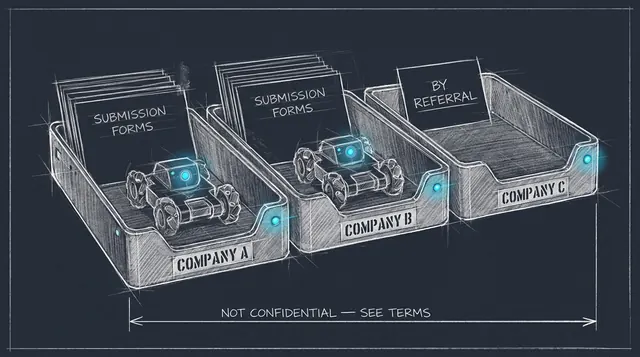
Short answer: Hasbro and Mattel each run an open, self-serve web portal that anyone 18 or older can use directly — Spark at spark.hasbro.com and My Mattel Ideas at mymattelideas.com. Spin Master has no equivalent open portal: it takes inquiries through a web form, but ideas mostly reach the company through its inventor-relations and advanced-concepts teams, agents, and pitch events. All three treat what you submit as non-confidential, and none pays anything unless and until they separately choose to make a deal.
This article compares process and public terms; it isn't legal advice, and it isn't a ranking. RoboSoccer, table soccer with real robot players, is a finished product we license directly to US partners rather than pitch through any of these three channels — there's a note on what that looks like at the end.
The three, at a glance
| Company | Channel | Who may submit | Is it confidential | If they want to use it |
|---|---|---|---|---|
| Hasbro | Spark portal, spark.hasbro.com — open web form | 18+, must own or control all rights, submission in English | No — the agreement states no relationship different from the general public is created | Toy-industry commentary quoting the agreement reports a cap of up to 1.5% of net sales, for up to 12 years |
| Mattel | My Mattel Ideas, mymattelideas.com — open web form | 18+ (parent/guardian for a minor), US resident, not employed in the toy industry now or in the past two years | No — Mattel states it "does not and cannot accept" ideas "in confidence" | Only if Mattel separately offers a Royalty Agreement: up to 1.5% of Mattel's sales, on invoice price less a 10% deduction |
| Spin Master | No open self-serve portal; a web inquiry form exists, but its own terms discourage unsolicited use of it | In practice: agents, known inventors, students in its university toy-design partnership, or anyone reaching its inventor-relations or advanced-concepts team | No — unsolicited ideas become Spin Master's property, usable without compensation | No published rate |
Hasbro: an open portal, an algorithm, then a person
Spark is a public web form. Submitting is three steps: your contact details (Hasbro asks you not to include social media accounts or photos), the concept itself — sketches, CAD drawings, storyboards, a prototype, a "sizzle" video, and any granted patent information you have — and a category. You have to be 18 or older, and you have to own or control every right in what you submit; if someone else helped make it, they need to have agreed to the submission too. Everything has to be in English.
Hasbro's own description of what it's looking for is informal: "if your idea is one that we haven't already dreamed up, we are not currently working on, and hasn't been previously produced… then we will certainly consider it." Toy-industry trade coverage describes what happens next in two stages — an algorithm screens submissions for fit against Hasbro's existing and planned categories, then a person on Hasbro's team reviews whatever passes that filter. Older write-ups describe Spark as open to US residents only; the current submission-steps page states the age and ownership rules without repeating a country limit on that page, so it's worth checking directly when you submit.
On terms: the agreement presented in the Spark flow states plainly that submitting doesn't create a confidential relationship — Hasbro can treat what you send the way it would treat something a stranger said to it in public. If Hasbro does want to use an idea, toy and game designers who've gone through the process report that the agreement's own default royalty tops out at 1.5% of net sales, capped at 12 years. That's below the 3–5% The Toy Association's own inventor guide describes as typical for a concept license — worth knowing before you accept whatever a portal offers as a starting point, not a final one.
Mattel: the same shape, a narrower door
My Mattel Ideas works the same way in outline — an open web form, no agent required — with a narrower eligibility gate. You must be a US resident, 18 or older (a parent or guardian submits for a minor), and you cannot currently work in the toy industry, or have worked in it within the past two years. Each idea gets its own submission, one at a time, with a product name, a description, what makes it different, and ideally a video. Review starts with a single Mattel employee and typically takes four to six weeks; you'll get an email either way, but Mattel won't discuss a pending submission with you outside that process, and you can't edit it after you've sent it.
Mattel is explicit that this is not a confidential process: the agreement states Mattel "does not and cannot accept" your product "in confidence," and it may show what you submit to other people at the company without any confidentiality obligation attaching. Submitting doesn't hand Mattel your idea, either — you keep your rights unless Mattel separately offers, and you separately sign, a Royalty Agreement. When that happens, the number quoted is up to 1.5% of Mattel's sales of the qualifying product, and the base itself is narrowed further: it's calculated on the invoice price Mattel bills its own customers, less a 10% deduction. On a $20 invoice price, that ceiling works out to about 27 cents a unit — the ceiling, not a rate Mattel discloses for the deals it negotiates directly with professional inventors.
Spin Master: no equivalent open door
Spin Master is the odd one out. Toy-trade coverage describes an internal "advanced concepts team" dedicated to sourcing new ideas, and the company has partnered with Toronto's Ryerson University (since renamed Toronto Metropolitan University) on what's described as Canada's first toy-invention program, pairing students with Spin Master's own people and prototyping resources. There is a web inquiry form where an outside inventor can submit a concept and supporting materials. But Spin Master's own terms of use go out of their way to say the company does not accept or consider creative ideas, suggestions or inventions other than ones it has specifically requested — and that anything sent anyway is non-confidential and becomes Spin Master's property, usable for any purpose without compensation.
In practice, industry coverage of how outside ideas actually reach Spin Master points to the same handful of routes every year: agents who already have a relationship with the company, and pitch events such as Toy Fair, the Mojo Pitch event, and the People of Play inventor conference, where Hasbro, Mattel, Spin Master and other major toy companies all appear looking for ideas in one room. If you don't have an agent or an invitation to one of those, the honest answer is that Spin Master doesn't offer the self-serve path Hasbro and Mattel do.
Why "not confidential" is standard, not a red flag
All three companies' terms land in the same place, and it isn't an accident. A toy company sees thousands of ideas a year, many of them close variations on things already in development. Without a blanket non-confidentiality clause, any new product risks a claim from someone who submitted something similar months earlier, whether or not their idea actually influenced the result. Treating unsolicited submissions as non-confidential, and disclaiming any implied deal, is the standard way large consumer companies protect themselves from that exposure — it shows up in Hasbro's and Mattel's own portals and in Spin Master's general terms of use alike. It does mean you should never send a company the one detail that makes your concept defensible before you've protected it some other way — a provisional patent filing, a copyright registration, or, at minimum, your own dated record.
If you already have a finished product, not just an idea
Everything above describes concept-stage submissions: a sketch, a prototype, a pitch deck. A finished, working hardware product — designs, firmware, an app, footage of real use, and the accumulated know-how — is a different conversation, closer to what a licensing deal with an established toy company actually looks like once it's signed. How to license a hardware product to a US partner walks through that process in four steps, using RoboSoccer as the worked example, and robotics toy IP available to license sets out what a licensable package looks like in practice. RoboSoccer itself is licensed openly and non-exclusively — see three ways to bring a robot soccer platform to market for the three ways to engage, or glossary: non-exclusive license for what that term means. Toy companies can start a conversation directly, no portal required.
Key facts
Hasbro's Spark portal requires submitters to be at least 18 years old, to own or control all rights in the concept, and to submit in English; Hasbro describes choosing "the absolute best ideas" for prototyping.
Source · https://spark.hasbro.com/ and https://spark.hasbro.com/submit/steps (checked September 2026)
Toy Book's inventor guide describes Hasbro's Spark as open to anyone in the US aged 18 or older, screened first by an algorithm and then reviewed by a Hasbro team member; it also describes Spin Master's inquiry form, internal advanced-concepts team, and toy-invention partnership with Toronto's Ryerson University.
Source · https://toybook.com/toy-inventors-from-idea-to-reality/
My Mattel Ideas restricts submissions to US residents 18 or older who are not currently, and have not within the past two years been, employed in the toy industry; Mattel "does not and cannot accept" a submitted product "in confidence."
Source · https://www.mymattelideas.com/ideas/myidea
Under Mattel's submission agreement, any royalty is capped at up to 1.5% of Mattel's sales of the qualifying product, calculated on the invoice price less a 10% deduction, and only applies if Mattel separately offers a Royalty Agreement; initial review is by a single Mattel employee and typically takes four to six weeks.
Source · https://www.mymattelideas.com/ideas/myidea and https://www.mymattelideas.com/ideas/faq
Spin Master's terms of use state the company does not accept or consider creative ideas, suggestions or inventions other than those it has specifically requested, and that an unsolicited submission becomes Spin Master's property, usable without compensation and without any confidentiality obligation.
Source · https://privacy.spinmaster.com/spin-master-terms-of-use (checked September 2026)
Toy-industry commentary quoting Hasbro's Spark Concept Disclosure Agreement directly describes a default royalty of "not more than one and one half percent (1.5%)" of net sales, capped at 12 years — well below the 3–5% of net sales The Toy Association's own inventor guide describes as typical for a licensed toy concept.
Source · https://pamwallsgamedesign.substack.com/p/15-royalty-is-not-okay
FAQ
- How do I submit a toy idea to Hasbro?
- Through Spark, at spark.hasbro.com. You'll need to be 18 or older, own or control all rights in the concept, and submit in English. The process is a public web form, not an agent introduction.
- Does Mattel pay for toy ideas?
- Only if Mattel separately offers you a Royalty Agreement after reviewing your My Mattel Ideas submission — the submission itself creates no payment obligation. When a Royalty Agreement is offered, the rate is capped at up to 1.5% of Mattel's sales of the qualifying product.
- Can anyone submit an idea to Spin Master?
- There's a web inquiry form, but Spin Master's own terms describe unsolicited ideas as unwanted, and industry coverage says most ideas the company acts on arrive through agents, its inventor-relations and advanced-concepts teams, or pitch events, not the cold web form.
- Is my toy idea confidential once I submit it to a toy company?
- No, at all three companies. Hasbro, Mattel and Spin Master each state in their terms that an unsolicited submission is not confidential and creates no special relationship, so they're free to use similar ideas from other sources without owing you anything.
- Do I need a patent before I submit a toy idea to a toy company?
- None of the three requires one. But because submissions are treated as non-confidential, having some form of dated protection or record — a provisional patent application, at minimum your own documented creation date — before you submit protects you regardless of what any single company does with your idea.
- Do I need an agent to pitch a toy idea to Hasbro, Mattel or Spin Master?
- Not for Hasbro or Mattel, both of which accept direct submissions from individual inventors through their own portals. For Spin Master, an agent or an introduction through a pitch event is, in practice, closer to how most outside ideas reach the company.
Want to build it in America?
Three clear ways to partner with us.
License the technology, co-develop and launch, or brand and grow the platform. Tell us about your company and we'll set up a short call.
Start a conversation