Short answer: Manufacturing a robotics toy yourself means committing to tooling, a minimum order quantity, safety and radio-frequency certification, import tariffs, and holiday-season returns risk, all before you know whether it sells. Licensing the technology to an established toy company trades a share of revenue — publicly reported rates run from about 3% to the high teens of net sales, depending on the kind of license — for someone else to carry that manufacturing risk instead. Below is the public cost math behind that trade-off, category by category, with a hypothetical worked example at the end. None of the numbers below are RoboSoccer's own costs or prices, which we don't publish.
Two different bets
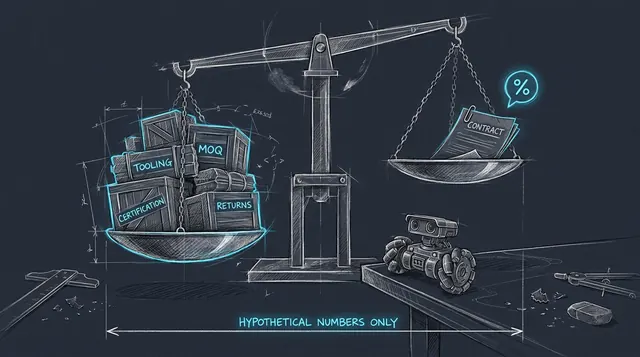
Manufacturing yourself means you pay for tooling, buy in factory-minimum quantities, certify the product, import it, and carry the inventory — and you keep whatever margin is left after a retailer takes its cut. Licensing means a toy company that already runs that supply chain pays you a percentage of what it sells, and it carries the manufacturing bet instead of you. Neither is free of risk; the risk just sits with a different party, and the two paths need very different amounts of your own cash before you see the first dollar back.
What manufacturing costs before you sell a single unit
Tooling. A robotics toy needs at least one injection mold for its plastic housing, usually several — a chassis, gears, battery covers, packaging inserts. Mold cost depends on cavity count, part size, complexity, and the steel grade used (soft tooling for a short run, hardened steel rated for a million-plus shots for a long one), and published sourcing guides put the range at "a few thousand dollars" for a simple, low-volume tool up to "hundreds of thousands" for a complex, high-volume one. A product with moving mechanical parts and multiple plastic components is priced on the higher end of that range, one mold at a time.
Minimum order quantity. Factories set a minimum production run to make the setup worth their time, and the number depends on what's being ordered. Sourcing guides put custom-tooled products at roughly 1,000 to 10,000-plus units, and electronics built around a custom PCB at roughly 500 to 5,000 units. A robotics toy is both at once — custom-tooled and custom electronics — so its practical floor sits where those two ranges overlap, and toward the higher end of it, not the low end either one quotes alone. Every unit in that minimum run is cash spent before the first sale, whether or not it sells through.
Safety and radio certification. A toy sold to US buyers for children 12 and under needs third-party testing against ASTM F963 under CPSIA, from a CPSC-accepted lab, plus a Children's Product Certificate. One such lab quotes $420–$570 for ASTM F963-23 testing and $1,000–$1,500 for the CPC itself, depending on how many materials are in the product. Add wireless control — Bluetooth, a proprietary radio link, an app pairing — and FCC certification comes on top: the same lab quotes roughly $1,200 and up for a Bluetooth-class FCC ID, more for a fully custom radio that isn't built on an already-certified module. None of this is optional, and all of it is paid before a unit ships.
Import duty. A toy manufactured in China and imported to the US carries a 0% base US tariff under HTS 9503 (toys, dolls, puzzles, models). On top of that, Chinese-origin toys carried roughly 20% in combined Section 301 duties through most of 2026 — a longstanding 7.5% List 4A rate plus a 12.5% Section 301 forced-labor surcharge added July 24, 2026. That number is a moving target: the US and China announced a tariff-relief agreement on September 27, 2026 that names toys among the goods getting reduced rates, with the finalized number still pending a formal USTR notice as of this writing. Whatever the exact rate, the duty lands on whoever imports the product, and an established toy company's existing supply chain is generally better positioned to absorb or route around tariff changes than a first-time importer is.
| Cost category | Typical range | Who carries it |
|---|---|---|
| Injection tooling (per mold) | A few thousand dollars to hundreds of thousands | Whoever manufactures |
| Minimum order quantity | ~500–5,000 units (custom electronics) to 1,000–10,000+ (custom tooling) | Whoever manufactures |
| ASTM F963 / CPSIA testing | $420–$570 per test cycle | Whoever manufactures |
| CPC certification | $1,000–$1,500 | Whoever manufactures |
| FCC certification (Bluetooth-class) | ~$1,200 and up | Whoever manufactures |
| Section 301 tariffs (China-origin) | ~20% on top of a 0% base rate (HTS 9503) through most of 2026; falling under a Sept. 2026 US–China deal, final rate pending | Whoever imports |
What manufacturing risks after you sell it
Getting a unit made and imported is the first bet. Selling it through retail is the second. A common rule of thumb for a hardware product is that the retail price runs two to four times the landed manufacturing cost, ideally at least three times, with the difference split between the brand's own margin, any distributor, and the retailer — a structure sometimes called keystone pricing at its simplest, doubling cost to set the shelf price. That multiple is what has to cover marketing, warehousing, customer support, and returns, not just profit.
Returns are a real number in toys specifically. US toy returns are estimated at $6–9 billion a year against a roughly $42 billion market — a 16.9% retail return rate in 2024 — and that rate climbs to 20–25% in the holiday season, when most toys sell. Of what comes back, roughly half is resold, another fifth to a quarter is liquidated at a discount, and the rest is donated or destroyed. Every one of those outcomes returns less cash than the original sale, and the inventory risk — unsold stock left after the season it was built for — sits with whoever owns the manufacturing.
What licensing trades away instead
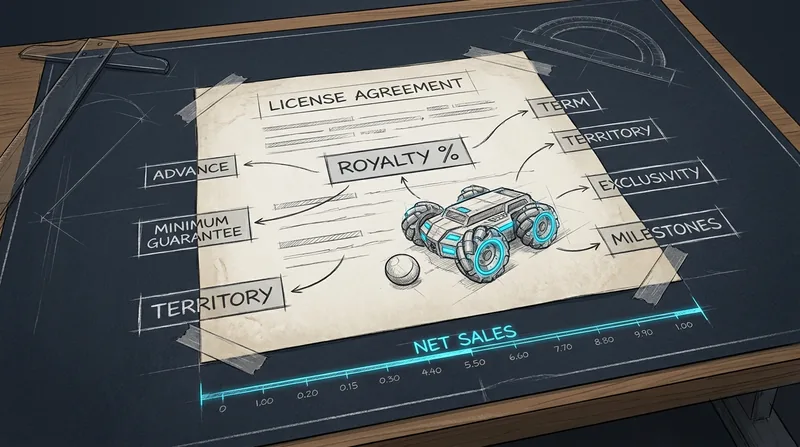
A license moves that risk to the licensee and replaces it with a percentage. Publicly reported rates vary by what's being licensed: The Toy Association's own inventor guide puts a concept or invention license at 3–5% of the licensee's net sales, since the licensee is the one paying for tooling, certification, and marketing. Brand and character licenses, where the licensor's name is doing the selling rather than an as-yet-unproven mechanism, run higher — JAKKS Pacific's public filings describe a range of 1% to 22% of net sales across its licenses, and Funko reported an average royalty of 17.4% in 2025. WIPO's licensing manual notes that royalties are calculated on net sales specifically so that costs unrelated to the licensed technology, like packaging and freight, don't shrink the licensor's take.
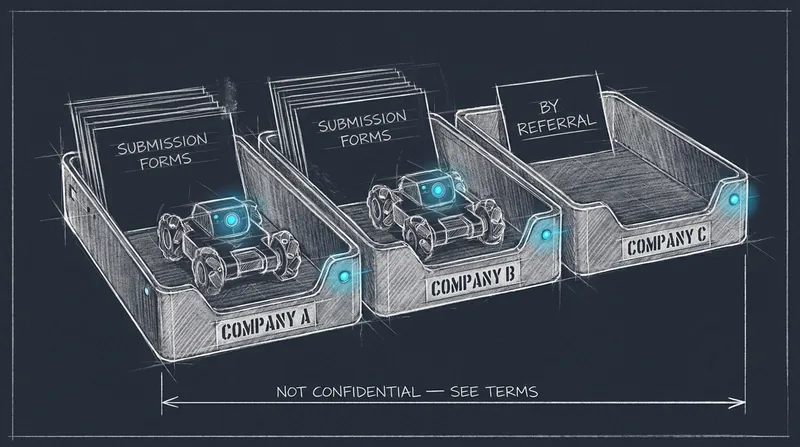
The licensor gives up the multiple a retailer sees — keystone pricing on landed cost, potentially 2–4x — in exchange for a royalty on what the licensee actually sells, with no tooling bill, no minimum order quantity, no certification cost, and no returns risk attached to their own balance sheet. What a licensor keeps is the option to license to more than one partner: a non-exclusive deal can run alongside other non-exclusive deals in ways a single manufacturing commitment cannot.
A worked example (hypothetical numbers only)
To make the trade-off concrete, here is a fictional example using round numbers chosen only to illustrate the mechanics — not RoboSoccer's own bill of materials, cost, or retail price, none of which we publish.
Say a hypothetical robotics toy has a landed manufacturing cost of $30 a unit, sold at retail for $100 (a bit above the 3x rule of thumb, to leave room for a distributor). A factory's minimum order is 3,000 units.
Manufacturing it yourself means committing roughly $90,000 in landed cost for that first production run, before tooling (call it $25,000 across two or three molds), before certification (call it $3,000 for safety and wireless testing together), and before Section 301 tariffs on the landed cost if it's made in China — call it 20%, or $18,000 more (the rate most likely to have changed by the time you read this; see the key facts below). That's north of $135,000 committed before the first retail sale, with a 16.9% chance in a typical year that any given unit sold comes back as a return, and a higher chance than that in the holiday season.
Licensing the technology to an established toy company instead means none of that capital is yours to commit. At a 5% royalty on net sales — in the range The Toy Association describes for a concept license — 3,000 units sold at, say, a $50 wholesale price pays $7,500. At 30,000 units across a full season, the same rate pays $75,000, with zero tooling, MOQ, certification, or returns risk carried by the licensor. The trade is real in both directions: manufacturing yourself keeps a much larger share of each sale, if it sells, and licensing accepts a smaller share in exchange for someone else absorbing the up-front bet and the downside.
Which one fits your situation
The math favors manufacturing yourself when you already have, or can raise, six figures of working capital, an existing relationship with a factory and a certified supply chain, and a sales channel that doesn't depend on winning space at a major retailer cold. It favors licensing when the hard, uncertain part — proving the product works and that people want it — is already done, and what's missing is the manufacturing and retail machinery to take it to volume. That is the position a finished, play-validated hardware product is usually in, and it's why how to license a hardware product to a US partner frames licensing as a way to monetize the invention and let a partner do what it's already built to do. RoboSoccer takes that path itself, openly and non-exclusively; see robotics toy IP available to license for what that package includes, or start a conversation directly.
Key facts
Injection mold tooling for a plastic part typically costs "a few thousand dollars" for a simple, low-volume tool up to "hundreds of thousands" for a complex, high-volume one, depending on cavity count, part complexity and steel grade.
Source · https://qualityinspection.org/injection-mould-cost/
Minimum order quantities in Chinese manufacturing run roughly 500–5,000 units for products built around custom electronics and roughly 1,000–10,000-plus units for custom-tooled products.
Source · https://www.plutoniaglobal.com/guides/minimum-order-quantities-china
One CPSC-accepted testing lab quotes $420–$570 for ASTM F963-23 toy safety testing and $1,000–$1,500 for a Children's Product Certificate; a Bluetooth-class FCC ID runs roughly $1,200 and up.
Source · https://www.jjrlab.com/news/how-much-does-the-astm-f963-23-toy-testing-cost.html, https://www.jjrlab.com/news/how-much-does-a-cpc-certification-cost.html, https://www.jjrlab.com/news/bluetooth-fcc-certification-cost.html
Toys imported from China under HTS 9503 carried a 0% base US tariff plus roughly 20% in combined Section 301 duties through most of 2026 — a 7.5% List 4A rate plus a 12.5% forced-labor-related surcharge effective July 24, 2026. On September 27, 2026, the US and China announced a tariff-relief deal naming toys among the covered goods, with the finalized rate pending formal USTR notice as of this writing — verify the current rate before relying on this figure.
Source · https://www.mallorygroup.com/blog-posts/forced-labor-tariffs-begin-july-24-what-the-10-and-12-5-tariff-changes-mean-for-your-cargo, https://toybook.com/us-china-agree-to-30b-tariff-cuts-toys-included/ (checked September 29, 2026)
US toy returns are estimated at $6–9 billion a year against a roughly $42 billion market — a 16.9% retail return rate in 2024 that climbs to 20–25% during the holiday season; of what's returned, roughly half is resold, 20–25% liquidated, and the rest donated or destroyed.
Source · https://natlawreview.com/press-releases/new-research-reveals-6-9-billion-worth-toys-are-returned-every-year-us-most, https://toycycle.co/pages/the-state-of-toy-returns-2026
A hardware product's retail price typically runs two to four times its landed manufacturing cost, ideally at least three times, to leave room for the brand's own margin, a distributor, and the retailer.
Source · https://predictabledesigns.com/how-to-price-your-new-electronic-hardware-product/
FAQ
- Is it cheaper to license a toy or manufacture it yourself?
- There's no single answer — it depends on volume. Manufacturing yourself keeps more of each sale once tooling, certification and minimum-order costs are paid off, but all of that is cash committed up front, at real risk, before you know if the product sells. Licensing gives up a share of revenue — publicly reported rates run from about 3% to the high teens of net sales, depending on the kind of license — in exchange for someone else carrying that risk.
- How much does it cost to manufacture an electronic toy?
- It varies by product, but the fixed costs before the first sale typically include injection tooling (a few thousand to hundreds of thousands of dollars per mold), safety testing under ASTM F963 and CPSIA (several hundred to low thousands of dollars), and, for a wireless product, FCC certification (roughly $1,200 and up). On top of that is the per-unit landed cost multiplied by the factory's minimum order quantity, commonly several hundred to several thousand units.
- What is a typical minimum order quantity for a toy?
- Sourcing guides put custom-tooled toys at roughly 1,000 to 10,000-plus units and products built around custom electronics at roughly 500 to 5,000 units. A robotics toy combining both tends toward the higher end of that overlap.
- Do I have to pay tariffs if I manufacture a toy in China?
- Yes. Toys under HTS 9503 carry a 0% base US tariff, but Chinese-origin toys carried roughly 20% in combined Section 301 duties through most of 2026 (a 7.5% rate plus a 12.5% forced-labor surcharge added that July) — a cost that lands on whoever imports the product. The US and China announced a deal on September 27, 2026 to lower tariffs on a list of goods that includes toys; the finalized rate was not yet public as of this writing, so check the current rate before budgeting against it.
- What percentage royalty does a toy license typically pay?
- Publicly reported ranges vary by license type: The Toy Association describes 3–5% of net sales as typical for licensing a concept or invention, while brand and character licenses run higher — JAKKS Pacific reports 1–22% across its licenses, and Funko's average was 17.4% in 2025.
- How much inventory risk does a toy manufacturer carry?
- A meaningful amount. US toy returns run an estimated $6–9 billion a year, a 16.9% retail return rate that climbs to 20–25% during the holiday season when most toys sell, and unsold seasonal stock left over after that window is a separate risk on top of returns.
Want to build it in America?
Three clear ways to partner with us.
License the technology, co-develop and launch, or brand and grow the platform. Tell us about your company and we'll set up a short call.
Start a conversation